
Seampal: Designing a Business Tool for Independent Tailors
For most tailors and fashion designers in Nigeria and the UK, business operations look something like this: client measurements scribbled in notebooks, order details scattered across WhatsApp threads, payment records kept in memory, and a lot of missed deadlines.
It works – until it doesn’t. Measurements get lost. Clients get frustrated. Deadlines sneak past. Money comes in, but nobody can say with confidence how much went out.
The problem isn’t that these businesses or individuals lack ambition. It’s that the tools available to them were never built for them. Existing tools feel like homework and too bloated for their workflow.
That’s why I built Seampal – a business management tool that helps tailors and fashion designers organize their clients, measurements, orders, payments, and public presence in one place. It replaces the scattered systems tailors currently rely on – paper notebooks, WhatsApp chats, and memory – with a single, practical app built for how they actually work.
- Role: Entire product lifecycle
- The team: Solo (Design, Frontend, Backend). Built with Opencode and Claudecode
- Year: 2026
- Platform: Web (Responsive), Mobile app in progress
💡 Background
It started on a regular evening. My girlfriend needed a client’s body measurements for an order she was working on. What followed was nearly two hours of both of us searching through stacks of notebooks, loose papers, and old WhatsApp messages.
She eventually found them. But the frustration stuck with me.
As a curious product designer and a problem solver, I asked myself:
Why is this so hard? Surely there’s a tool for this.
Initial Hypothesis
Tailors lack organization infrastructure that fits their workflow. The problem isn’t capability. It’s that the operational side of their business (measurements, payments, client details, order status) lives in too many disconnected places.
Why Existing Tools Fail
I looked at what was available. What I found:
- Generic CRM tools (HubSpot, Zoho) – built for sales teams, not solo craftspeople. Overwhelming, irrelevant features.
- Tailoring-specific apps – either outdated, designed for large ateliers with staff, or focused on pattern-making rather than business operations.
- Note-taking apps – flexible but unstructured. A tailor saving measurements in Apple Notes still can’t find them 3 months later.
The gap was clear: no tool was built for the solo tailor’s actual workflow – someone who manages 10 – 50 clients, juggles orders via WhatsApp, tracks payments mentally, and runs their entire business from their phone.
I saw an opportunity to build something that truly help them feel organized and more productive.
My Role
I was responsible for the entire product lifecycle: research, product strategy, brand identity, UI/UX design, frontend development, backend architecture, and deployment. This was a solo build from the ground up – from the first user conversation to the production release.
My focus was on making decisions that kept the product grounded in the reality of how fashion businesses actually operate, rather than building features that sounded impressive on a feature list but would never get used.
Primary Research: Interviews with 8+ Tailors
Before designing anything, I spent time understanding the specific frustrations that tailors and fashion designers deal with daily, after observing my girlfriend’s daily workflow for a week, I conducted interviews with 8 tailors across different experience levels and business sizes. The goal was simple:
What frustrates you about the non-sewing parts of your job?
-
1
Lost or hard-to-find measurements Every tailor had a story about spending 20+ minutes looking for a client's measurements — or worse, having to re-measure because records were lost. -
2
Scattered financial records Money comes in through transfers, cash, and deposits - but there's no clean record of what was earned versus what was spent and more importantly, how they were growing as a business -
3
Not tax compliant Businesses rarely used financial tools like invoices and receipts and they barely kept a trail for audit purposes -
4
Software anxiety Most available tools felt too complex, too generic, or too corporate. Users felt like they needed to become "tech-savvy" just to manage their business. -
5
No professional presence Many tailors want to appear more "established" to clients but don't have a website, portfolio, or any digital presence beyond Instagram posts.
Framing the Challenge
With a clear and empathetic understanding of the user needs, the next step was to synthesize these complex human needs into a focused, actionable design challenge. I used the “How Might We” (HMW) framework to reframe the problems as opportunities. This transformed the pain points from a list of user complaints into a clear, optimistic mission statement that would guide the entire ideation process
-
1
How might we give tailors a tool that feels as natural as the notebook they're replacing - but more reliable? -
2
How might we help fashion businesses present themselves professionally online without needing a website builder? -
3
How might we make financial visibility effortless for people who don't think in accounting terms?
Crafting the Experience
I anchored the design around five principles that came directly from the research:
-
1
Serve the craft, not the software Every screen reflects how tailors actually think and work - by client, by order, by deadline. Information is organized the way a tailor would reach for it. -
2
Simplicity over completeness These users switched from WhatsApp and notes, not Excel. I prioritized clear single-action flows over feature density. The app should never make users feel like the tool is bigger than their problem. -
3
Professional without corporate. The visual language needed to feel organized, trustworthy, and polished - without feeling cold or enterprise-heavy. -
4
Financial clarity at a glance Orders, payments, and expenses are the heartbeat of the business. Balances and overdue items should be immediately readable without navigation or calculation. -
5
No professional presence Many tailors want to appear more "established" to clients but don't have a website, portfolio, or any digital presence beyond Instagram posts.
The Seampal Experience
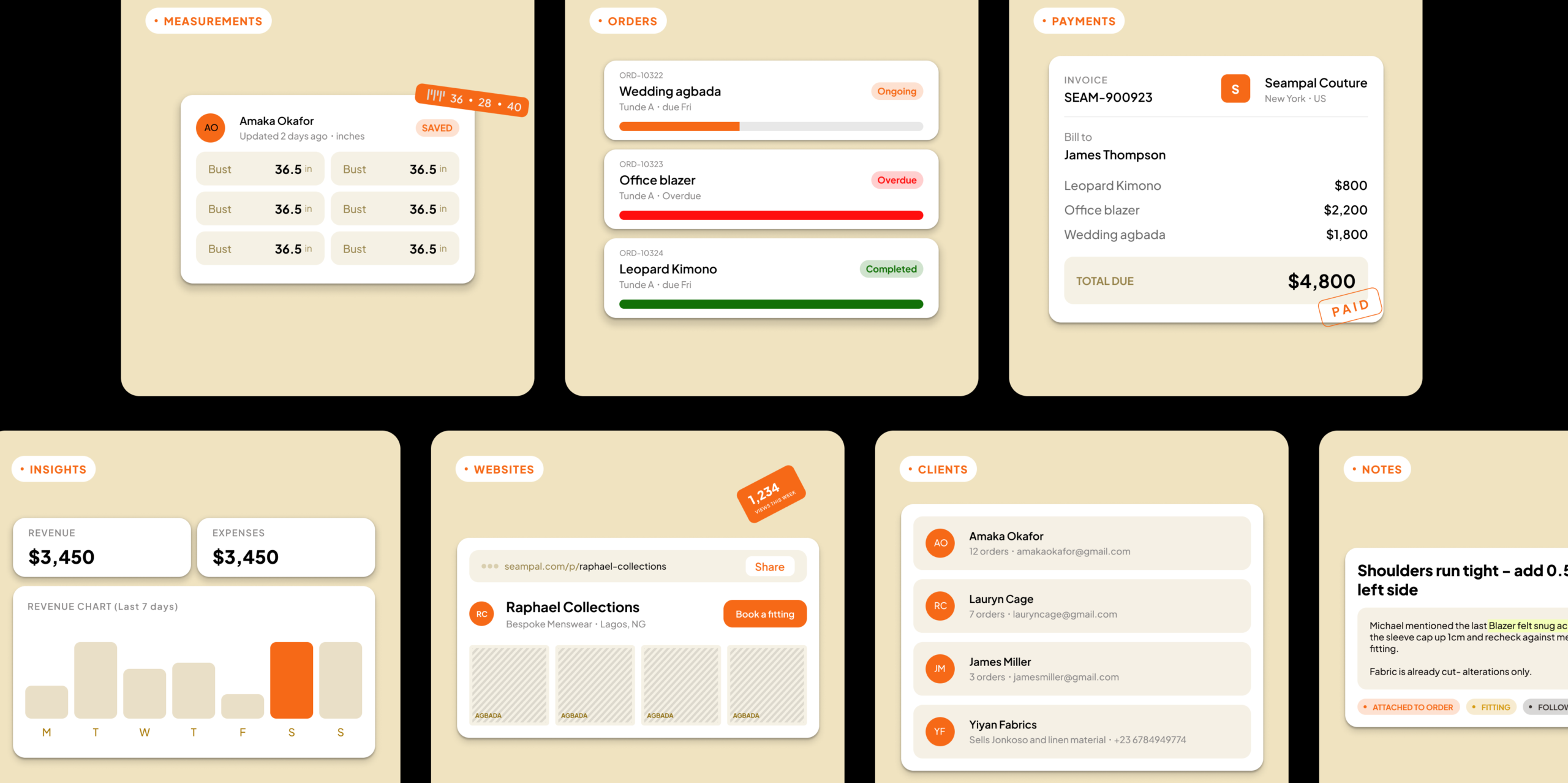
The dashboard is built around urgency, not vanity metrics. It surfaces:
- Orders that need attention (due soon, overdue, unpaid)
- Recent payments received
- Upcoming fittings
- A financial summary (income vs. expenses)
A tailor opening the app at 8am should know within three seconds what needs their attention today.
Client Management - The Digital Client Book
Each client has a profile with their contact details, full measurement history, linked orders, and payment records. Measurements are grouped by category (chest, waist, sleeve length, inseam) and support both centimeters and inches.
The critical design decision here was supporting multiple measurement sets per client. A client’s measurements for a formal suit differ from their casual wear measurements. Tailors think this way – the app reflects it.
Order Tracking - From Commission to Delivery
Orders flow through clear statuses: pending, in-progress, completed. Each order tracks:
- The client it belongs to
- Payment status and history
- Due date with urgency indicators
- Linked expenses
The order detail view was designed so a tailor can glance at it and immediately know: who is this for, when is it due, and have they paid?
Invoices - Professional Documents in Seconds
Tailors can generate invoices from order details, preview them, and share them as PDFs. The invoice includes business details, itemized work, payment status, and a professional layout.
For many users, this is the first time they’ve been able to send a client a proper invoice instead of a WhatsApp message saying “your balance is ₦25,000.”
Public Profile - A Lightweight Business Page
Every user gets a shareable profile page at `seampal.co/p/your-name`. It includes:
- Business name and description
- Portfolio galler- Services offered
- Social links and contact information
This addresses a real emotional need. Many tailors felt their business wasn’t “real” because they didn’t have a website. The public profile gives them a professional page they can share with confidence – no website builder required.
Reflection & Key Takeaways
-
1
Domain immersion changes everything The most valuable design decisions came from understanding how tailors actually work - not from best practices or competitor analysis. Spending time in workshops and having conversations about daily routines surfaced insights that no amount of desk research would have produced. -
2
Simplicity is a design decision, not a limitation At every stage, I had to resist the pull to add more. More fields, more statuses, more settings, more features. The users I was designing for didn't need more - they needed less, done well. The hardest design work was deciding what to leave out. -
3
Solo doesn't mean isolated Building this alone meant wearing every hat - researcher, designer, developer, product manager. But the users were always part of the process. Their language shaped the interface. Their workflows shaped the architecture. Their anxiety about software shaped the onboarding. The product is a solo build, but it was never built in isolation. -
4
AI and Product Development AI is often discussed as a replacement for people. In my experience building Seampal, it was the opposite — it was an amplifier. It amplified my ability to act on user insights quickly. It amplified my ability to test ideas by making implementation cheap. It amplified my reach as a solo builder. AI didn't replace product thinking. It removed the bottleneck between knowing what to build and actually building it. For a solo product person with a clear vision, AI is the engineering team that lets you move at the speed of your ideas.